
Root resorption: braces or aligners?
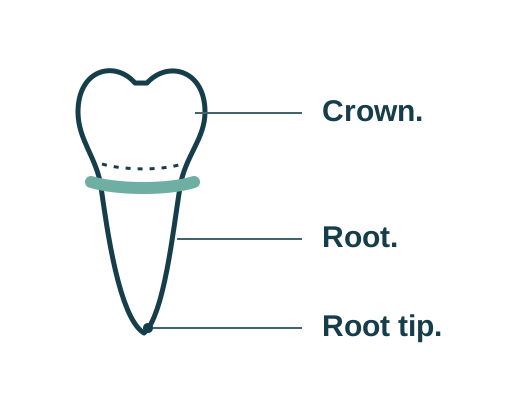
Orthodontically induced external apical root resorption is loss of hard tissue at a tooth's root tip. It concerns the root, not simply how straight the visible teeth look. Other forms and causes of resorption need separate assessment. ↗
Conceptual illustration · unscaled
Evidence with limits.
Root shortening occurred with both appliances in a small randomized study of selected adults. It found no statistically significant difference between Invisalign® and fixed appliances. That does not prove equal risk or predict a rare severe outcome. ↗
The adult comparison excluded prior orthodontic treatment, upper-incisor trauma and pre-existing resorption. Its averages cannot simply predict outcomes for people with those histories or for children. ↗
A separate six-month adult open-bite trial found less shortening with an in-house aligner-plus-exercise protocol, alongside less achieved molar intrusion than miniscrew-assisted fixed treatment. This does not establish a general aligner safety advantage. ↗
| Root shortening. | Less |
|---|---|
| Achieved intrusion. | Less |
In this trial, less measured root shortening accompanied less achieved molar intrusion.
Sources
Related guides: Imaging · Retreatment